9.4.5
Photosynthesis Experiments
Test your knowledge with free interactive questions on Seneca — used by over 10 million students.
Using Chromatography to Investigate Photosynthesis
Chromatography is a technique that can be used to identify which pigments are in the leaves of different plants. This allows us to identify what wavelengths of light a plant can absorb.

1) Extract the chlorophyll
- Take some leaves from a plant that grows in the shade.
- Place boiling water from a kettle into a beaker and dip a few leaves to kill them.
- Tear up the leaves and grind with 5-10 cm3 of acetone in a pestle and mortar until you obtain a dark green chlorophyll extract. Add a pinch of sand to break up the cells.
 8.1.3.1 - Paper chromatography apparatus,h_400,q_80,w_640.jpg)
2) Add the chlorophyll
- Use a strip of chromatography paper, which fits into a boiling tube without touching the sides. Mark a line 1.5 cm from the bottom in pencil and in the centre put a cross.
- Mark another line 2 cm from the top of the paper.
- Pick up your chlorophyll solution using a capillary tube and place on the cross. Allow to dry.
- Repeat 4-5 times to have a small, dense green spot.

3) Suspend the paper
- Put 1.5 cm of acetone/petroleum solvent into the bottom of the boiling tube, using a funnel to avoid wetting the sides.
- Suspend the paper using a drawing pin so that it just touches the solvent and leave.

4) Repeat the experiment
- Repeat steps 1-3 using leaves from a plant that grows well in direct sunlight.
- Remove the paper from each boiling tube when the solvent reaches the line at the top of the papers. Mark the positions of the pigments before they fade.

5) Calculate Rf
- Calculate the Rf values using:
- Rf = distance travelled by spot ÷ distance travelled by solvent
- Find the pigment that corresponds with the given Rf value.
Investigating Dehydrogenase Activity in Chloroplasts
During the light-dependent reaction, NADP is reduced to NADPH. A dehydrogenase enzyme catalyses this reaction. This experiment will monitor dehydrogenase activity by using DCPIP, a redox indicator.
DCPIP
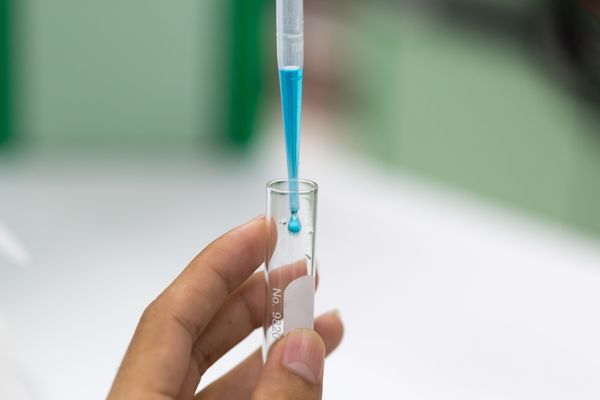
- In this investigation, a blue dye (DCPIP) is used to monitor the rate of dehydrogenase activity. DCPIP is a redox indicator.
- This means that it is blue in the oxidised state and colourless in its reduced state.
- When electrons are released by the chlorophyll, DCPIP will change from blue to colourless.

1) Extracting chloroplasts
- Put 50 cm3 of isolation medium into a beaker.
- Tear eight spinach leaves into small pieces and put the pieces into the isolation medium in the beaker.
- Do NOT put pieces of the midrib or the leaf stalk into the beaker.
- Half fill a large beaker with ice and place a small beaker on top of the ice.
- When carrying out this step, all solutions and apparatus should be kept as cold as possible and the extraction should be carried out as quickly as possible.

2) Suspending chloroplasts
- Put 3 layers of muslin over the top of the filter funnel and wet with the isolation medium. Rest the filter funnel in the small beaker on the ice.
- Pour the spinach and isolation medium into the blender and blend for 15 seconds. Pour the blended mixture back into the beaker.
- Pour your blended mixture through the muslin in the filter funnel. Carefully squeeze the muslin to assist the filtering process.
- Label this filtrate which is in the small beaker on ice as ‘chloroplast suspension’.

3) Set up tubes A and B
- Label five test tubes A, B, C, X and Y and stand them in the large beaker. Put the lamp about 10 cm away so that all tubes are illuminated. Set up tubes A and B as follows:
- Tube A - 5 cm3 DCPIP solution + 1 cm3 water + 1 cm3 chloroplast suspension. Immediately wrap the tube in aluminium foil to exclude light.
- Tube B - 5 cm3 DCPIP solution + 1 cm3 water + 1 cm3 isolation medium.
- Tubes A and B are control experiments. Leave both tubes until the end of your investigation.
4) Set up tube C
- Set up tube C as follows:
- Tube C - 6 cm3 water + 1 cm3 chloroplast suspension.
- Tube C is for you to use as a standard to help you to determine when any colour change is complete.

5) Set up tube X
- Set up tube X as follows:
- Tube X - 5 cm3 DCPIP solution + 1 cm3 water in the tube.
- Add 1 cm3 chloroplast suspension to tube X, quickly mix the contents and start the timer.
- Record in seconds how long it takes for the contents of tube X to change colour from blue-green to green. Use tube C to help you determine when the colour change is complete.
- Repeat this step four more times.
6) Set up tube Y
- Set up tube Y as follows:
- Tube Y - 5 cm3 DCPIP solution + 1 cm3 ammonium hydroxide.
- Add 1 cm3 chloroplast suspension to tube Y, quickly mix the contents and start the timer.
- Record in seconds how long it takes for the contents of tube Y to change colour from blue-green to green. Use tube C to help you determine when the colour change is complete.
- Repeat this step four more times.

7) Record the results
- Record your data in a suitable table.
- At the end of your investigation, record the colour of the mixtures in tubes A and B.
1Unity & Diversity - Molecules
1.1Water
1.2DNA Structure & Replication
1.3Transcription & Gene Expression
2Unity & Diversity - Cells
2.1The Origin of Cells
2.2Introduction to Cells
2.3Ultrastructure of Cells
2.4Cell Division
2.5Structure of DNA & RNA
2.6DNA Replication, Transcription & Translation
2.7Cell Respiration
2.8Photosynthesis
2.9Viruses
3Unity & Diversity - Organisms
3.1Diversity of Organisms
3.2Evidence for Evolution
4Unity & Diversity - Ecosystems
4.1Classification
4.3Evolution & Speciation
4.3.1Evidence for Evolution - Fossils & DNA4.3.2Evidence for Evolution - Anatomy & Geography4.3.3IB Multiple Choice - Evidence for Evolution4.3.4Extended Response - DNA & Evolution4.3.5Populations4.3.6Mutations, Genetic Drift, & Gene Flow4.3.7Speciation4.3.8Rate of Speciation4.3.9Allopatric & Sympatric Speciation
4.4Conservation of Biodiversity
5Form & Function - Molecules
6Form & Function - Cells
6.1Membranes & Membrane Transport
6.2Organelles & Compartmentalization
6.3Cell Specialization
7Form & Function - Organisms
7.2Transport
7.3Muscle & Motility
8Form & Function - Ecosystems
8.1Species, Communities & Ecosytems
8.3Carbon Cycle
9Interaction & Interdependence - Molecules
9.1Enzymes
9.2Metabolism
9.3Cell Respiration
10Interaction & Interdependence - Cells
10.1Chemical Signalling
10.2Neural Signalling
10.3Adaptation to Environment
10.4Ecological Niches
11Interaction & Interdependence - Organisms
11.1Integration of Body Systems
12Interaction & Interdependence - Ecosystems
12.1Populations & Communities
12.2Transfers of Energy & Matter
13Continuity & Change - Molecules
13.1DNA Replication
13.2Protein Synthesis
14Continuity & Change - Cells
15Continuity & Change - Organisms
15.1Inheritance
15.1.1Non-Nuclear Inheritance15.1.2Linked Genes15.1.3IB Multiple Choice - Non-Mendelian Genetics15.1.4Extended Response - Inheritance15.1.5Introduction to Non-Mendelian Inheritance15.1.6Chi-Squared Test15.1.7End of Topic Quiz - Inheritance15.1.8Sex-Linked Genes15.1.9Grade 4-5 (Scientific Practices) - Inheritance
16Continuity & Change - Ecosystems
16.1Natural Selection
16.2Stability & Change
Jump to other topics
1Unity & Diversity - Molecules
1.1Water
1.2DNA Structure & Replication
1.3Transcription & Gene Expression
2Unity & Diversity - Cells
2.1The Origin of Cells
2.2Introduction to Cells
2.3Ultrastructure of Cells
2.4Cell Division
2.5Structure of DNA & RNA
2.6DNA Replication, Transcription & Translation
2.7Cell Respiration
2.8Photosynthesis
2.9Viruses
3Unity & Diversity - Organisms
3.1Diversity of Organisms
3.2Evidence for Evolution
4Unity & Diversity - Ecosystems
4.1Classification
4.3Evolution & Speciation
4.3.1Evidence for Evolution - Fossils & DNA4.3.2Evidence for Evolution - Anatomy & Geography4.3.3IB Multiple Choice - Evidence for Evolution4.3.4Extended Response - DNA & Evolution4.3.5Populations4.3.6Mutations, Genetic Drift, & Gene Flow4.3.7Speciation4.3.8Rate of Speciation4.3.9Allopatric & Sympatric Speciation
4.4Conservation of Biodiversity
5Form & Function - Molecules
6Form & Function - Cells
6.1Membranes & Membrane Transport
6.2Organelles & Compartmentalization
6.3Cell Specialization
7Form & Function - Organisms
7.2Transport
7.3Muscle & Motility
8Form & Function - Ecosystems
8.1Species, Communities & Ecosytems
8.3Carbon Cycle
9Interaction & Interdependence - Molecules
9.1Enzymes
9.2Metabolism
9.3Cell Respiration
10Interaction & Interdependence - Cells
10.1Chemical Signalling
10.2Neural Signalling
10.3Adaptation to Environment
10.4Ecological Niches
11Interaction & Interdependence - Organisms
11.1Integration of Body Systems
12Interaction & Interdependence - Ecosystems
12.1Populations & Communities
12.2Transfers of Energy & Matter
13Continuity & Change - Molecules
13.1DNA Replication
13.2Protein Synthesis
14Continuity & Change - Cells
15Continuity & Change - Organisms
15.1Inheritance
15.1.1Non-Nuclear Inheritance15.1.2Linked Genes15.1.3IB Multiple Choice - Non-Mendelian Genetics15.1.4Extended Response - Inheritance15.1.5Introduction to Non-Mendelian Inheritance15.1.6Chi-Squared Test15.1.7End of Topic Quiz - Inheritance15.1.8Sex-Linked Genes15.1.9Grade 4-5 (Scientific Practices) - Inheritance
16Continuity & Change - Ecosystems
16.1Natural Selection
16.2Stability & Change
Practice questions on Photosynthesis Experiments
Can you answer these? Test yourself with free interactive practice on Seneca — used by over 10 million students.
- 1
- 2
- 3How are R<sub>f</sub> values calculated?Multiple choice
- 4Stages of Investigating Dehydrogenase ActivityPut in order
- 5
Unlock your full potential with Seneca Premium
Unlimited access to 10,000+ open-ended exam questions
Mini-mock exams based on your study history
Unlock 800+ premium courses & e-books