2.2.4
Eukaryotic vs Prokaryotic Cells
Test your knowledge with free interactive questions on Seneca — used by over 10 million students.
Eukaryotic vs Prokaryotic Cells
All life on Earth exists as cells. A cell is the smallest unit of a living thing. All cells can be grouped into either eukaryotic or prokaryotic cells. These different categories have similarities and differences.

Similarities
- Both prokaryotic and eukaryotic cells contain organelles.
- The cell-surface membrane in eukaryotic and prokaryotic cells is made of a phospholipid bilayer.
- This bilayer is responsible for controlling the passage of substances across exchange surfaces.

Differences
- Prokaryotic cells make up single-celled prokaryotic organisms (e.g. bacteria). In contrast, eukaryotic cells make up complex eukaryotic organisms (e.g. animals, plants, fungi and algae).
- Eukaryotic cells are larger and more complex than prokaryotic cells.
- Cells arise from other cells by binary fission in prokaryotic cells and by mitosis or meiosis in eukaryotic cells.
Types of Eukaryotic Cells
Eukaryotic cells have similar structures across different types of organisms. But there are some key differences that are outlined here.


Animal cell
- Most animal cells have the following organelles:
- Mitochondria.
- Ribosomes.
- Endoplasmic reticulum (ER).
- Golgi.
- Lysosomes.
- Nucleus.
- Animal cells are enclosed by a cell membrane.
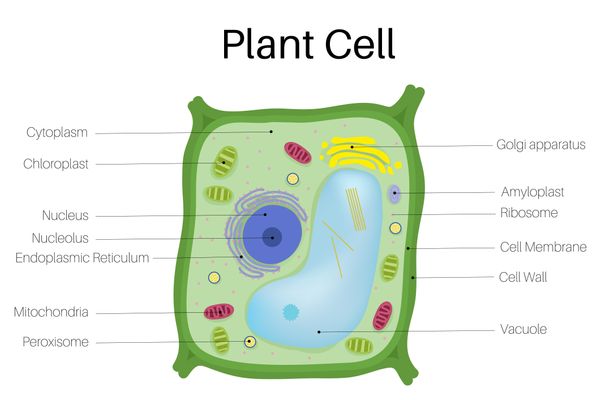
Plant cell
- Plant cells contain all the organelles found in animal cells.
- Plant cells also possess:
- Vacuole (a repository of cell sap).
- Chloroplasts (the site of photosynthesis).
- Cell wall (made of cellulose and contains plasmodesmata, through which cells exchange substances with each other).

Algal cells
- Algal cells and plant cells have an identical set of organelles.

Fungal cells
- Fungal cells are similar to plant cells, apart from:
- There are no chloroplasts in fungal cells.
- The cell walls of fungal cells are made from chitin instead of cellulose.
Specialisation and Organisation of Cells
In complex multicellular organisms, cells gain specific features. This is called specialisation. Specialised cells are then organised into groups to perform a function.

Cell specialisation
- A cell specialises because the shape and contents of a cell help it to carry out its function. Examples include:
- Muscle cells are very active so contain lots of mitochondria in order to produce ATP.
- Red blood cells have a biconcave shape and no nucleus to maximise space to carry oxygen. They also have lots of haemoglobin.
- Palisade cells have a long, upright shape and contain chlorophyll to absorb light for photosynthesis.

Cell organisation
- Specialised cells are organised into tissues, tissues into organs and organs into organ systems.
- Tissues (e.g. muscle tissue, xylem tissue).
- Organs (e.g. the animal heart or plant leaf).
- Organ systems (e.g. the female reproductive system, which includes the uterus, ovaries, mammary glands and breasts).
1Unity & Diversity - Molecules
1.1Water
1.2DNA Structure & Replication
1.3Transcription & Gene Expression
2Unity & Diversity - Cells
2.1The Origin of Cells
2.2Introduction to Cells
2.3Ultrastructure of Cells
2.4Cell Division
2.5Structure of DNA & RNA
2.6DNA Replication, Transcription & Translation
2.7Cell Respiration
2.8Photosynthesis
2.9Viruses
3Unity & Diversity - Organisms
3.1Diversity of Organisms
3.2Evidence for Evolution
4Unity & Diversity - Ecosystems
4.1Classification
4.3Evolution & Speciation
4.4Conservation of Biodiversity
5Form & Function - Molecules
6Form & Function - Cells
6.1Membranes & Membrane Transport
6.2Organelles & Compartmentalization
6.3Cell Specialization
7Form & Function - Organisms
7.2Transport
7.3Muscle & Motility
8Form & Function - Ecosystems
8.1Species, Communities & Ecosytems
8.3Carbon Cycle
9Interaction & Interdependence - Molecules
9.1Enzymes
9.2Metabolism
9.3Cell Respiration
10Interaction & Interdependence - Cells
10.1Chemical Signalling
10.2Neural Signalling
10.3Adaptation to Environment
10.4Ecological Niches
11Interaction & Interdependence - Organisms
11.1Integration of Body Systems
12Interaction & Interdependence - Ecosystems
12.1Populations & Communities
12.2Transfers of Energy & Matter
13Continuity & Change - Molecules
13.1DNA Replication
13.2Protein Synthesis
14Continuity & Change - Cells
15Continuity & Change - Organisms
15.1Inheritance
16Continuity & Change - Ecosystems
16.1Natural Selection
16.2Stability & Change
Jump to other topics
1Unity & Diversity - Molecules
1.1Water
1.2DNA Structure & Replication
1.3Transcription & Gene Expression
2Unity & Diversity - Cells
2.1The Origin of Cells
2.2Introduction to Cells
2.3Ultrastructure of Cells
2.4Cell Division
2.5Structure of DNA & RNA
2.6DNA Replication, Transcription & Translation
2.7Cell Respiration
2.8Photosynthesis
2.9Viruses
3Unity & Diversity - Organisms
3.1Diversity of Organisms
3.2Evidence for Evolution
4Unity & Diversity - Ecosystems
4.1Classification
4.3Evolution & Speciation
4.4Conservation of Biodiversity
5Form & Function - Molecules
6Form & Function - Cells
6.1Membranes & Membrane Transport
6.2Organelles & Compartmentalization
6.3Cell Specialization
7Form & Function - Organisms
7.2Transport
7.3Muscle & Motility
8Form & Function - Ecosystems
8.1Species, Communities & Ecosytems
8.3Carbon Cycle
9Interaction & Interdependence - Molecules
9.1Enzymes
9.2Metabolism
9.3Cell Respiration
10Interaction & Interdependence - Cells
10.1Chemical Signalling
10.2Neural Signalling
10.3Adaptation to Environment
10.4Ecological Niches
11Interaction & Interdependence - Organisms
11.1Integration of Body Systems
12Interaction & Interdependence - Ecosystems
12.1Populations & Communities
12.2Transfers of Energy & Matter
13Continuity & Change - Molecules
13.1DNA Replication
13.2Protein Synthesis
14Continuity & Change - Cells
15Continuity & Change - Organisms
15.1Inheritance
16Continuity & Change - Ecosystems
16.1Natural Selection
16.2Stability & Change
Practice questions on Eukaryotic vs Prokaryotic Cells
Can you answer these? Test yourself with free interactive practice on Seneca — used by over 10 million students.
- 1
- 2Which cells contain organelles?Multiple choice
- 3Which of these organelles are NOT found in animal cells?Multiple choice
- 4
- 5Which of these eukaryotes does NOT have a cell wall?Multiple choice
Unlock your full potential with Seneca Premium
Unlimited access to 10,000+ open-ended exam questions
Mini-mock exams based on your study history
Unlock 800+ premium courses & e-books