11.2.3
Antibodies
Test your knowledge with free interactive questions on Seneca — used by over 10 million students.
Structure
Antibodies are proteins called immunoglobulins that are produced by the plasma cells during the immune response. The antibodies are called monoclonal antibodies.

Variable regions
- Each antibody has two variable regions.
- Each antibody has different variable regions.
- The variable regions bind specifically to specific antigens.
- One antibody can bind two antigens. This allows the antigens to be clumped together in agglutination.
Constant regions
- Every antibody has the same constant regions.
Disulphide bridge
- Antibodies are made from two heavy chains and two light chains.
- The heavy chains are connected to the light chains by disulphide bridges.
Hinge protein
- The hinge protein connects the variable region to the constant region.
Uses of Monoclonal Antibodies
Monoclonal antibodies can be used in the following ways:

Targeted medication
- Cancer cells in the body have antigens that signal the cells as abnormal.
- Monoclonal antibodies in cancer treatment can be used to bind specifically to the antigens on cancer cells.
- Cancer treatments can be harmful to many cells. By binding specifically to cancer cells, the antibodies allow the treatment to be targeted to only the cancer cells.
- This reduces damage to other cells.

Medical diagnosis
- Monoclonal antibodies can be used to indicate the presence of a specific antigen.
- The antibodies are attached to a dye, fluorescent or radioactive marker.
- When the complementary antigen is present, it will bind the antibody and the marker will become visible.
- Monoclonal antibodies are used in this way in pregnancy tests.
ELISA Test
Antibodies can be used in the enzyme-linked immunosorbent assay (ELISA) test. ELISA test tests for infections (e.g. HIV) or allergies. The steps involved are:

1) Fixing of the antigens
- The antigen for the infection that is being tested for is immobilised to the bottom of a beaker.

2) Addition of the blood
- A sample of the blood that is being investigated is added to the beaker.
- If the antibodies that are complementary to the disease-causing antigen are present in the blood, they will bind to the antigens at the bottom of the beaker to form many antigen-antibody complexes.
3) Washing of the beaker
- The beaker is washed out so that any antibodies that have not bound to antigens are removed.
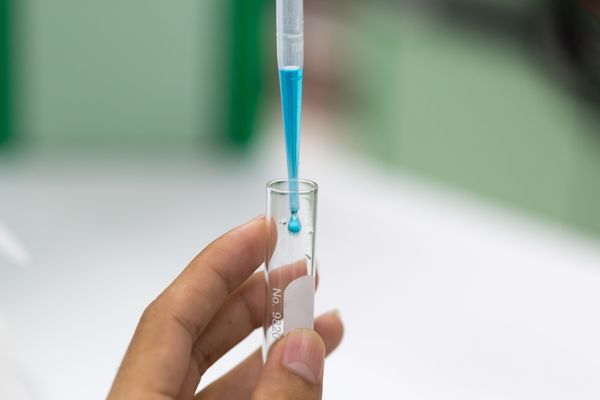
4) Secondary antibodies
- Secondary antibodies are added to the solution.
- The secondary antibodies are bound to an enzyme.
- If a secondary antibody binds to the other antibodies from the blood sample, the enzyme will change the colour of a solution in the beaker.

5) Addition of the solution
- The solution that reacts with the enzymes on the secondary antibodies is added.
- If the solution changes colour, the secondary antibodies have bound to the antibodies from the blood sample.
- This indicates the blood sample is infected by the pathogen.
1Unity & Diversity - Molecules
1.1Water
1.2DNA Structure & Replication
1.3Transcription & Gene Expression
2Unity & Diversity - Cells
2.1The Origin of Cells
2.2Introduction to Cells
2.3Ultrastructure of Cells
2.4Cell Division
2.5Structure of DNA & RNA
2.6DNA Replication, Transcription & Translation
2.7Cell Respiration
2.8Photosynthesis
2.9Viruses
3Unity & Diversity - Organisms
3.1Diversity of Organisms
3.2Evidence for Evolution
4Unity & Diversity - Ecosystems
4.1Classification
4.3Evolution & Speciation
4.3.1Evidence for Evolution - Fossils & DNA4.3.2Evidence for Evolution - Anatomy & Geography4.3.3IB Multiple Choice - Evidence for Evolution4.3.4Extended Response - DNA & Evolution4.3.5Populations4.3.6Mutations, Genetic Drift, & Gene Flow4.3.7Speciation4.3.8Rate of Speciation4.3.9Allopatric & Sympatric Speciation
4.4Conservation of Biodiversity
5Form & Function - Molecules
6Form & Function - Cells
6.1Membranes & Membrane Transport
6.2Organelles & Compartmentalization
6.3Cell Specialization
7Form & Function - Organisms
7.2Transport
7.3Muscle & Motility
8Form & Function - Ecosystems
8.1Species, Communities & Ecosytems
8.3Carbon Cycle
9Interaction & Interdependence - Molecules
9.1Enzymes
9.2Metabolism
9.3Cell Respiration
10Interaction & Interdependence - Cells
10.1Chemical Signalling
10.2Neural Signalling
10.3Adaptation to Environment
10.4Ecological Niches
11Interaction & Interdependence - Organisms
11.1Integration of Body Systems
12Interaction & Interdependence - Ecosystems
12.1Populations & Communities
12.2Transfers of Energy & Matter
13Continuity & Change - Molecules
13.1DNA Replication
13.2Protein Synthesis
14Continuity & Change - Cells
15Continuity & Change - Organisms
15.1Inheritance
15.1.1Non-Nuclear Inheritance15.1.2Linked Genes15.1.3IB Multiple Choice - Non-Mendelian Genetics15.1.4Extended Response - Inheritance15.1.5Introduction to Non-Mendelian Inheritance15.1.6Chi-Squared Test15.1.7End of Topic Quiz - Inheritance15.1.8Sex-Linked Genes15.1.9Grade 4-5 (Scientific Practices) - Inheritance
16Continuity & Change - Ecosystems
16.1Natural Selection
16.2Stability & Change
Jump to other topics
1Unity & Diversity - Molecules
1.1Water
1.2DNA Structure & Replication
1.3Transcription & Gene Expression
2Unity & Diversity - Cells
2.1The Origin of Cells
2.2Introduction to Cells
2.3Ultrastructure of Cells
2.4Cell Division
2.5Structure of DNA & RNA
2.6DNA Replication, Transcription & Translation
2.7Cell Respiration
2.8Photosynthesis
2.9Viruses
3Unity & Diversity - Organisms
3.1Diversity of Organisms
3.2Evidence for Evolution
4Unity & Diversity - Ecosystems
4.1Classification
4.3Evolution & Speciation
4.3.1Evidence for Evolution - Fossils & DNA4.3.2Evidence for Evolution - Anatomy & Geography4.3.3IB Multiple Choice - Evidence for Evolution4.3.4Extended Response - DNA & Evolution4.3.5Populations4.3.6Mutations, Genetic Drift, & Gene Flow4.3.7Speciation4.3.8Rate of Speciation4.3.9Allopatric & Sympatric Speciation
4.4Conservation of Biodiversity
5Form & Function - Molecules
6Form & Function - Cells
6.1Membranes & Membrane Transport
6.2Organelles & Compartmentalization
6.3Cell Specialization
7Form & Function - Organisms
7.2Transport
7.3Muscle & Motility
8Form & Function - Ecosystems
8.1Species, Communities & Ecosytems
8.3Carbon Cycle
9Interaction & Interdependence - Molecules
9.1Enzymes
9.2Metabolism
9.3Cell Respiration
10Interaction & Interdependence - Cells
10.1Chemical Signalling
10.2Neural Signalling
10.3Adaptation to Environment
10.4Ecological Niches
11Interaction & Interdependence - Organisms
11.1Integration of Body Systems
12Interaction & Interdependence - Ecosystems
12.1Populations & Communities
12.2Transfers of Energy & Matter
13Continuity & Change - Molecules
13.1DNA Replication
13.2Protein Synthesis
14Continuity & Change - Cells
15Continuity & Change - Organisms
15.1Inheritance
15.1.1Non-Nuclear Inheritance15.1.2Linked Genes15.1.3IB Multiple Choice - Non-Mendelian Genetics15.1.4Extended Response - Inheritance15.1.5Introduction to Non-Mendelian Inheritance15.1.6Chi-Squared Test15.1.7End of Topic Quiz - Inheritance15.1.8Sex-Linked Genes15.1.9Grade 4-5 (Scientific Practices) - Inheritance
16Continuity & Change - Ecosystems
16.1Natural Selection
16.2Stability & Change
Practice questions on Antibodies
Can you answer these? Test yourself with free interactive practice on Seneca — used by over 10 million students.
- 1
- 2What structure of the antibody binds to specific antigens?Multiple choice
- 3Which of these is NOT a use of monoclonal antibodies?Multiple choice
- 4Uses of monoclonal antibodies:Fill in the list
- 5
Unlock your full potential with Seneca Premium
Unlimited access to 10,000+ open-ended exam questions
Mini-mock exams based on your study history
Unlock 800+ premium courses & e-books