8.1.5
Nutrient Cycles
Test your knowledge with free interactive questions on Seneca — used by over 10 million students.
Saprobionts
Saprobionts are microorganisms (e.g. bacteria and fungi) that feed on dead or decaying organic matter. Saprobionts play an important role in decomposition and in recycling nutrients.

Importance of nutrient recycling
- Nutrient recycling is an important process in ecosystems because it allows the nutrients to be continuously reused.
- Nutrients are recycled in the nitrogen cycle by saprobionts.
Saprobiont nutrition
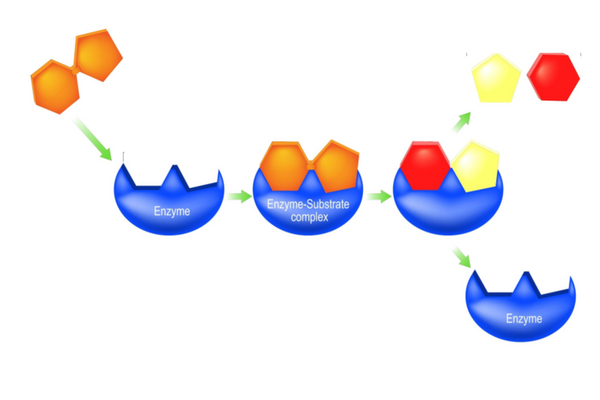
- Saprobionts secrete enzymes onto the dead organic matter. This is called extracellular digestion.
- The enzymes break down large, insoluble molecules into smaller, soluble molecules.
- These smaller molecules can then be absorbed by the saprobiont.
- The saprobiont will then either store the molecules or use them in respiration.
Role in nitrogen cycle
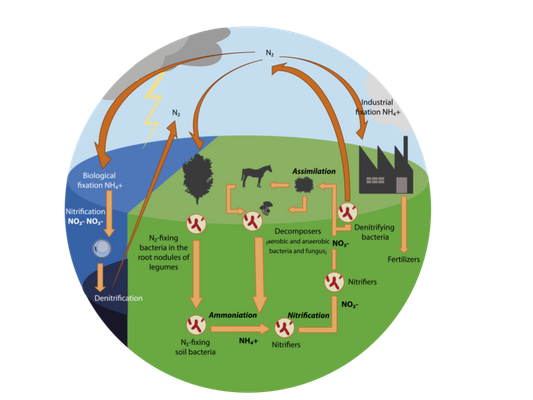
- Saprobionts are important in the ammonification stage of the nitrogen cycle.
- Through extracellular digestion, saprobionts break down organic matter that contains nitrogen (e.g. urea, proteins, nucleic acids).
- Ammonium ions are released as a result of extracellular digestion.
- These ions then move onto the next stage of the nitrogen cycle: nitrification.
Nitrogen Cycle
The nitrogen cycle shows how nitrogen is transferred between organisms and their ecosystem. There are four steps in the nitrogen cycle, each of which involves bacteria:

1) Nitrogen fixation
- Atmospheric nitrogen (N2) is converted to ammonia (NH3) by nitrogen-fixing bacteria in the soil.
- Bacteria (e.g. Rhizobia) form a mutualistic relationship with leguminous plants by inhabiting their root nodules.
- Leguminous plants (e.g. alfalfa, peas, beans) are a family of plants.
- The bacteria provide a source of ammonium ions for the plants and the plant provides sugars.
decompose-decay-animal-dead-nitrogen-cycle-,h_400,q_80,w_640.jpg)
2) Ammonification
- When an organism dies or produces waste (e.g. faeces), it is decomposed by saprobionts.
- This releases the nutrients contained inside.
- Saprobionts decompose the organisms' biomass by extracellular digestion and inorganic ammonium ions are released into the soil.
- Ammonification is a by-product of saprobiont nutrition.
3) Nitrification
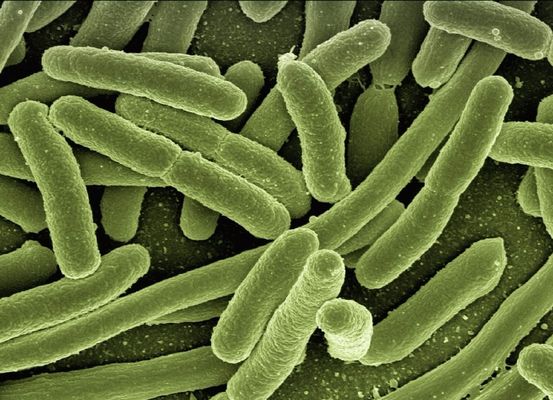
- Ammonium ions that are released from ammonification are converted into nitrates by bacteria in the soil.
- Nitrifying bacteria (e.g. Nitrosomonas) firstly convert NH4+ ions to nitrites.
- Another bacteria (e.g. Nitrobacter) then convert nitrites to nitrates.
4) Denitrification
- Denitrifying bacteria convert nitrates in the soil back into atmospheric nitrogen (N2).
- This takes place in anaerobic conditions (e.g waterlogged soils).
1Unity & Diversity - Molecules
1.1Water
1.2DNA Structure & Replication
1.3Transcription & Gene Expression
2Unity & Diversity - Cells
2.1The Origin of Cells
2.2Introduction to Cells
2.3Ultrastructure of Cells
2.4Cell Division
2.5Structure of DNA & RNA
2.6DNA Replication, Transcription & Translation
2.7Cell Respiration
2.8Photosynthesis
2.9Viruses
3Unity & Diversity - Organisms
3.1Diversity of Organisms
3.2Evidence for Evolution
4Unity & Diversity - Ecosystems
4.1Classification
4.3Evolution & Speciation
4.3.1Evidence for Evolution - Fossils & DNA4.3.2Evidence for Evolution - Anatomy & Geography4.3.3IB Multiple Choice - Evidence for Evolution4.3.4Extended Response - DNA & Evolution4.3.5Populations4.3.6Mutations, Genetic Drift, & Gene Flow4.3.7Speciation4.3.8Rate of Speciation4.3.9Allopatric & Sympatric Speciation
4.4Conservation of Biodiversity
5Form & Function - Molecules
6Form & Function - Cells
6.1Membranes & Membrane Transport
6.2Organelles & Compartmentalization
6.3Cell Specialization
7Form & Function - Organisms
7.2Transport
7.3Muscle & Motility
8Form & Function - Ecosystems
8.1Species, Communities & Ecosytems
8.3Carbon Cycle
9Interaction & Interdependence - Molecules
9.1Enzymes
9.2Metabolism
9.3Cell Respiration
10Interaction & Interdependence - Cells
10.1Chemical Signalling
10.2Neural Signalling
10.3Adaptation to Environment
10.4Ecological Niches
11Interaction & Interdependence - Organisms
11.1Integration of Body Systems
12Interaction & Interdependence - Ecosystems
12.1Populations & Communities
12.2Transfers of Energy & Matter
13Continuity & Change - Molecules
13.1DNA Replication
13.2Protein Synthesis
14Continuity & Change - Cells
15Continuity & Change - Organisms
15.1Inheritance
15.1.1Non-Nuclear Inheritance15.1.2Linked Genes15.1.3IB Multiple Choice - Non-Mendelian Genetics15.1.4Extended Response - Inheritance15.1.5Introduction to Non-Mendelian Inheritance15.1.6Chi-Squared Test15.1.7End of Topic Quiz - Inheritance15.1.8Sex-Linked Genes15.1.9Grade 4-5 (Scientific Practices) - Inheritance
16Continuity & Change - Ecosystems
16.1Natural Selection
16.2Stability & Change
Jump to other topics
1Unity & Diversity - Molecules
1.1Water
1.2DNA Structure & Replication
1.3Transcription & Gene Expression
2Unity & Diversity - Cells
2.1The Origin of Cells
2.2Introduction to Cells
2.3Ultrastructure of Cells
2.4Cell Division
2.5Structure of DNA & RNA
2.6DNA Replication, Transcription & Translation
2.7Cell Respiration
2.8Photosynthesis
2.9Viruses
3Unity & Diversity - Organisms
3.1Diversity of Organisms
3.2Evidence for Evolution
4Unity & Diversity - Ecosystems
4.1Classification
4.3Evolution & Speciation
4.3.1Evidence for Evolution - Fossils & DNA4.3.2Evidence for Evolution - Anatomy & Geography4.3.3IB Multiple Choice - Evidence for Evolution4.3.4Extended Response - DNA & Evolution4.3.5Populations4.3.6Mutations, Genetic Drift, & Gene Flow4.3.7Speciation4.3.8Rate of Speciation4.3.9Allopatric & Sympatric Speciation
4.4Conservation of Biodiversity
5Form & Function - Molecules
6Form & Function - Cells
6.1Membranes & Membrane Transport
6.2Organelles & Compartmentalization
6.3Cell Specialization
7Form & Function - Organisms
7.2Transport
7.3Muscle & Motility
8Form & Function - Ecosystems
8.1Species, Communities & Ecosytems
8.3Carbon Cycle
9Interaction & Interdependence - Molecules
9.1Enzymes
9.2Metabolism
9.3Cell Respiration
10Interaction & Interdependence - Cells
10.1Chemical Signalling
10.2Neural Signalling
10.3Adaptation to Environment
10.4Ecological Niches
11Interaction & Interdependence - Organisms
11.1Integration of Body Systems
12Interaction & Interdependence - Ecosystems
12.1Populations & Communities
12.2Transfers of Energy & Matter
13Continuity & Change - Molecules
13.1DNA Replication
13.2Protein Synthesis
14Continuity & Change - Cells
15Continuity & Change - Organisms
15.1Inheritance
15.1.1Non-Nuclear Inheritance15.1.2Linked Genes15.1.3IB Multiple Choice - Non-Mendelian Genetics15.1.4Extended Response - Inheritance15.1.5Introduction to Non-Mendelian Inheritance15.1.6Chi-Squared Test15.1.7End of Topic Quiz - Inheritance15.1.8Sex-Linked Genes15.1.9Grade 4-5 (Scientific Practices) - Inheritance
16Continuity & Change - Ecosystems
16.1Natural Selection
16.2Stability & Change
Practice questions on Nutrient Cycles
Can you answer these? Test yourself with free interactive practice on Seneca — used by over 10 million students.
- 1Which of these are NOT activities of saprobionts?Multiple choice
- 2
- 3Stages of the Nitrogen CyclePut in order
- 4
- 5
Unlock your full potential with Seneca Premium
Unlimited access to 10,000+ open-ended exam questions
Mini-mock exams based on your study history
Unlock 800+ premium courses & e-books