10.2.6
Types of Synapse
Test your knowledge with free interactive questions on Seneca — used by over 10 million students.
Neuromuscular Junction
A neuromuscular junction is a synapse between a motor neurone and a muscle cell. An action potential is transmitted across the synapse using the neurotransmitter acetylcholine. The steps involved are:

Arrival at the synaptic knob
- An action potential arrives at the synaptic knob at the end of the motor neurone.
- The action potential depolarises the membrane of the synaptic knob. This causes voltage-gated calcium (Ca2+) ion channels to open.
- Ca2+ ions diffuse into the synaptic knob.
Release of acetylcholine (ACh)
- The Ca2+ ion concentration inside the synaptic knob begins to increase.
- This causes the synaptic vesicles to move and fuse with the presynaptic membrane.
- Acetylcholine, the neurotransmitter inside the vesicles, is released into the synaptic cleft.
- This process is called exocytosis.
Binding to receptors
- Acetylcholine binds to specific receptors on the postsynaptic membrane called nicotinic cholinergic receptors.
- Binding of the neurotransmitter opens sodium ion channels in the postsynaptic muscle cell.
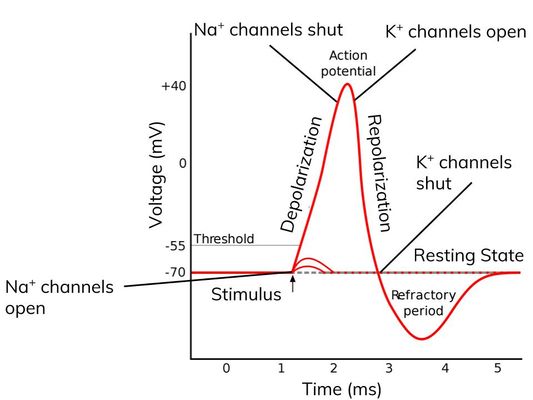
- As Na+ ions diffuse into the cell, the membrane becomes depolarised.
- If the potential difference reaches the threshold value, an action potential is generated and flows along the motor cell.
Removal of acetylcholine
- An enzyme called acetylcholinesterase (AChE) breaks down acetylcholine in the synaptic cleft.
- The products of the break down are reabsorbed by the presynaptic neurone and reused to synthesise more acetylcholine.
- It is important that the acetylcholine is removed from the receptors. This stops action potentials from being continuously generated in the postsynaptic cell.
Cholinergic Synapses
Synapses that use acetylcholine as a neurotransmitter are called cholinergic synapses. Although acetylcholine is also used at a neuromuscular junction, there are some key differences:

Type of postsynaptic cell
- Cholinergic synapses are between two neurones.
- Neuromuscular junctions are between a motor neurone and a muscle cell.

Number of receptors
- There are less receptors in the postsynaptic membrane at a cholinergic synapse than at a neuromuscular junction.

Type of response
- A cholinergic synapse can trigger an inhibitory or excitatory response in the postsynaptic membrane.
- An action potential at a neuromuscular junction always triggers an excitatory response in the muscle cell.
Result of depolarisation
- In a cholinergic synapse, depolarisation of the postsynaptic membrane results in an action potential.
- At a neuromuscular junction, depolarisation of the postsynaptic membrane results in muscle contraction.
,h_400,q_80,w_640.png)
Acetylcholinesterase
- Acetylcholinesterase is the enzyme that breaks down acetylcholine after it has bound to the receptors on the postsynaptic membrane.
- In cholinergic synapses, the enzyme is located in the synaptic cleft.
- At a neuromuscular junction, the enzyme is stored in clefts in the postsynaptic membrane.
1Unity & Diversity - Molecules
1.1Water
1.2DNA Structure & Replication
1.3Transcription & Gene Expression
2Unity & Diversity - Cells
2.1The Origin of Cells
2.2Introduction to Cells
2.3Ultrastructure of Cells
2.4Cell Division
2.5Structure of DNA & RNA
2.6DNA Replication, Transcription & Translation
2.7Cell Respiration
2.8Photosynthesis
2.9Viruses
3Unity & Diversity - Organisms
3.1Diversity of Organisms
3.2Evidence for Evolution
4Unity & Diversity - Ecosystems
4.1Classification
4.3Evolution & Speciation
4.3.1Evidence for Evolution - Fossils & DNA4.3.2Evidence for Evolution - Anatomy & Geography4.3.3IB Multiple Choice - Evidence for Evolution4.3.4Extended Response - DNA & Evolution4.3.5Populations4.3.6Mutations, Genetic Drift, & Gene Flow4.3.7Speciation4.3.8Rate of Speciation4.3.9Allopatric & Sympatric Speciation
4.4Conservation of Biodiversity
5Form & Function - Molecules
6Form & Function - Cells
6.1Membranes & Membrane Transport
6.2Organelles & Compartmentalization
6.3Cell Specialization
7Form & Function - Organisms
7.2Transport
7.3Muscle & Motility
8Form & Function - Ecosystems
8.1Species, Communities & Ecosytems
8.3Carbon Cycle
9Interaction & Interdependence - Molecules
9.1Enzymes
9.2Metabolism
9.3Cell Respiration
10Interaction & Interdependence - Cells
10.1Chemical Signalling
10.2Neural Signalling
10.3Adaptation to Environment
10.4Ecological Niches
11Interaction & Interdependence - Organisms
11.1Integration of Body Systems
12Interaction & Interdependence - Ecosystems
12.1Populations & Communities
12.2Transfers of Energy & Matter
13Continuity & Change - Molecules
13.1DNA Replication
13.2Protein Synthesis
14Continuity & Change - Cells
15Continuity & Change - Organisms
15.1Inheritance
15.1.1Non-Nuclear Inheritance15.1.2Linked Genes15.1.3IB Multiple Choice - Non-Mendelian Genetics15.1.4Extended Response - Inheritance15.1.5Introduction to Non-Mendelian Inheritance15.1.6Chi-Squared Test15.1.7End of Topic Quiz - Inheritance15.1.8Sex-Linked Genes15.1.9Grade 4-5 (Scientific Practices) - Inheritance
16Continuity & Change - Ecosystems
16.1Natural Selection
16.2Stability & Change
Jump to other topics
1Unity & Diversity - Molecules
1.1Water
1.2DNA Structure & Replication
1.3Transcription & Gene Expression
2Unity & Diversity - Cells
2.1The Origin of Cells
2.2Introduction to Cells
2.3Ultrastructure of Cells
2.4Cell Division
2.5Structure of DNA & RNA
2.6DNA Replication, Transcription & Translation
2.7Cell Respiration
2.8Photosynthesis
2.9Viruses
3Unity & Diversity - Organisms
3.1Diversity of Organisms
3.2Evidence for Evolution
4Unity & Diversity - Ecosystems
4.1Classification
4.3Evolution & Speciation
4.3.1Evidence for Evolution - Fossils & DNA4.3.2Evidence for Evolution - Anatomy & Geography4.3.3IB Multiple Choice - Evidence for Evolution4.3.4Extended Response - DNA & Evolution4.3.5Populations4.3.6Mutations, Genetic Drift, & Gene Flow4.3.7Speciation4.3.8Rate of Speciation4.3.9Allopatric & Sympatric Speciation
4.4Conservation of Biodiversity
5Form & Function - Molecules
6Form & Function - Cells
6.1Membranes & Membrane Transport
6.2Organelles & Compartmentalization
6.3Cell Specialization
7Form & Function - Organisms
7.2Transport
7.3Muscle & Motility
8Form & Function - Ecosystems
8.1Species, Communities & Ecosytems
8.3Carbon Cycle
9Interaction & Interdependence - Molecules
9.1Enzymes
9.2Metabolism
9.3Cell Respiration
10Interaction & Interdependence - Cells
10.1Chemical Signalling
10.2Neural Signalling
10.3Adaptation to Environment
10.4Ecological Niches
11Interaction & Interdependence - Organisms
11.1Integration of Body Systems
12Interaction & Interdependence - Ecosystems
12.1Populations & Communities
12.2Transfers of Energy & Matter
13Continuity & Change - Molecules
13.1DNA Replication
13.2Protein Synthesis
14Continuity & Change - Cells
15Continuity & Change - Organisms
15.1Inheritance
15.1.1Non-Nuclear Inheritance15.1.2Linked Genes15.1.3IB Multiple Choice - Non-Mendelian Genetics15.1.4Extended Response - Inheritance15.1.5Introduction to Non-Mendelian Inheritance15.1.6Chi-Squared Test15.1.7End of Topic Quiz - Inheritance15.1.8Sex-Linked Genes15.1.9Grade 4-5 (Scientific Practices) - Inheritance
16Continuity & Change - Ecosystems
16.1Natural Selection
16.2Stability & Change
Practice questions on Types of Synapse
Can you answer these? Test yourself with free interactive practice on Seneca — used by over 10 million students.
- 1What is a neuromuscular junction between?Multiple choice
- 2Transmission Across a Neuromuscular JunctionPut in order
- 3
- 4
- 5
Unlock your full potential with Seneca Premium
Unlimited access to 10,000+ open-ended exam questions
Mini-mock exams based on your study history
Unlock 800+ premium courses & e-books