10.2.8
Transmission of an Impulse
Test your knowledge with free interactive questions on Seneca — used by over 10 million students.
Resting Potential
When a neurone has not been stimulated, it is at resting state.

Potential difference
- At resting state there is a difference in charge across the neurone membrane: the inside of the neurone is more negatively charged than outside.
- This is because there are more positive ions outside the cell than inside.
- The difference in charge is called a potential difference.

Sodium-potassium pumps
- The resting potential is maintained by sodium-potassium pumps in the neurone membrane.
- Three Na+ ions are actively transported out of the neurone by the pumps for every two K+ ions that are transported in.
- This leads to a build-up of positive ions outside the cell.
Potassium ion channels
- There are potassium ion channels in the neurone membrane. This means it is permeable to K+ ions.
- When K+ ions are transported into neurones, they can diffuse back out.
- The neurone membrane is also impermeable to Na+ ions so the ions cannot diffuse back into the cell after they have been transported out.

Resting potential
- Together the action of sodium-potassium pumps and potassium ion channels leads to a potential difference across the neurone membrane.
- This potential difference is called the resting potential.
- The neurone is said to be polarised.
- Resting potential is about −70mV.
Depolarisation of the Neurone Cell Membrane
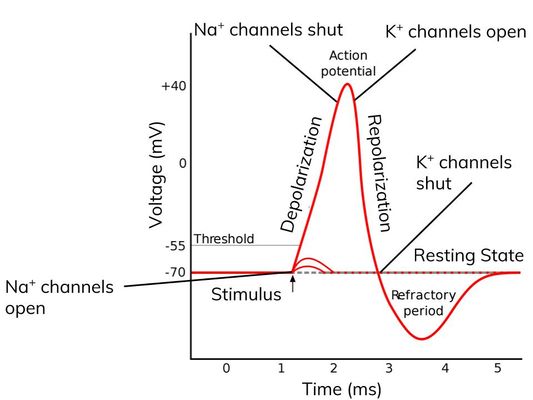
When a resting neurone is stimulated, its membrane experiences a change in potential difference. This change is called repolarisation. The steps are:
Stimulation
- Na+ ion channels in the cell membrane open when a neurone is stimulated.
- Na+ ions flood into the neurone.
- The potential difference across the membrane changes to become more positive inside the neurone.
Depolarisation
- If the potential difference increases above the threshold value (about −55mV) then the membrane will become depolarised.
- More sodium channels open and there is a sharp increase in potential difference to about +30mV.

All-or-nothing
- Depolarisation is an all-or-nothing response.
- If the potential difference reaches the threshold, depolarisation will always take place and the change in potential difference will always be the same.
- If the stimulus is stronger, action potentials will be produced more frequently but their size will not increase.

Repolarisation
- After the neurone membrane has depolarised to +30mV, the sodium ion channels close and potassium ion channels open.
- Na+ ions are transported back out of the neurone and the potential difference becomes more negative.
- This is called repolarisation.
Hyperpolarisation
- There is a short period after depolarisation of a neurone where the potential difference becomes slightly more negative than the resting potential.
- This is called hyperpolarisation.
- Hyperpolarisation prevents the neurone from being restimulated instantly. This is called the refractory period.
Resting potential
- After the refractory period, the potassium ion channels close and the membrane returns to its resting potential.
- The process where a neurone is depolarised and returns to resting potential is called an action potential.
Action Potential
The stages involved in the depolarisation of a neurone membrane are called an action potential. Action potentials move along the neurone in a wave.

Sodium ions
- When an action potential is generated, there are more Na+ ions inside the neurone than outside.
- Some of these Na+ ions diffuse sideways along the neurone axon.

Sodium ion channels
- The presence of Na+ ions creates a change in potential difference further along the neurone membrane.
- If this reaches the threshold value, sodium ion channels at this part of the membrane open.
- Na+ ions diffuse into the neurone.
- This part of the neurone now becomes depolarised.
Wave of depolarisation
- Na+ diffuse all along the neurone in this way.
- Depolarisation takes place along the neurone membrane. This creates a wave of depolarisation.
Refractory period
- The period of hyperpolarisation in an action potential is called the refractory period.
- The ion channels are recovering during the refractory period. This means an action potential cannot be stimulated again instantly.
- This ensures that the wave of depolarisation travels in one direction.
1Unity & Diversity - Molecules
1.1Water
1.2DNA Structure & Replication
1.3Transcription & Gene Expression
2Unity & Diversity - Cells
2.1The Origin of Cells
2.2Introduction to Cells
2.3Ultrastructure of Cells
2.4Cell Division
2.5Structure of DNA & RNA
2.6DNA Replication, Transcription & Translation
2.7Cell Respiration
2.8Photosynthesis
2.9Viruses
3Unity & Diversity - Organisms
3.1Diversity of Organisms
3.2Evidence for Evolution
4Unity & Diversity - Ecosystems
4.1Classification
4.3Evolution & Speciation
4.3.1Evidence for Evolution - Fossils & DNA4.3.2Evidence for Evolution - Anatomy & Geography4.3.3IB Multiple Choice - Evidence for Evolution4.3.4Extended Response - DNA & Evolution4.3.5Populations4.3.6Mutations, Genetic Drift, & Gene Flow4.3.7Speciation4.3.8Rate of Speciation4.3.9Allopatric & Sympatric Speciation
4.4Conservation of Biodiversity
5Form & Function - Molecules
6Form & Function - Cells
6.1Membranes & Membrane Transport
6.2Organelles & Compartmentalization
6.3Cell Specialization
7Form & Function - Organisms
7.2Transport
7.3Muscle & Motility
8Form & Function - Ecosystems
8.1Species, Communities & Ecosytems
8.3Carbon Cycle
9Interaction & Interdependence - Molecules
9.1Enzymes
9.2Metabolism
9.3Cell Respiration
10Interaction & Interdependence - Cells
10.1Chemical Signalling
10.2Neural Signalling
10.3Adaptation to Environment
10.4Ecological Niches
11Interaction & Interdependence - Organisms
11.1Integration of Body Systems
12Interaction & Interdependence - Ecosystems
12.1Populations & Communities
12.2Transfers of Energy & Matter
13Continuity & Change - Molecules
13.1DNA Replication
13.2Protein Synthesis
14Continuity & Change - Cells
15Continuity & Change - Organisms
15.1Inheritance
15.1.1Non-Nuclear Inheritance15.1.2Linked Genes15.1.3IB Multiple Choice - Non-Mendelian Genetics15.1.4Extended Response - Inheritance15.1.5Introduction to Non-Mendelian Inheritance15.1.6Chi-Squared Test15.1.7End of Topic Quiz - Inheritance15.1.8Sex-Linked Genes15.1.9Grade 4-5 (Scientific Practices) - Inheritance
16Continuity & Change - Ecosystems
16.1Natural Selection
16.2Stability & Change
Jump to other topics
1Unity & Diversity - Molecules
1.1Water
1.2DNA Structure & Replication
1.3Transcription & Gene Expression
2Unity & Diversity - Cells
2.1The Origin of Cells
2.2Introduction to Cells
2.3Ultrastructure of Cells
2.4Cell Division
2.5Structure of DNA & RNA
2.6DNA Replication, Transcription & Translation
2.7Cell Respiration
2.8Photosynthesis
2.9Viruses
3Unity & Diversity - Organisms
3.1Diversity of Organisms
3.2Evidence for Evolution
4Unity & Diversity - Ecosystems
4.1Classification
4.3Evolution & Speciation
4.3.1Evidence for Evolution - Fossils & DNA4.3.2Evidence for Evolution - Anatomy & Geography4.3.3IB Multiple Choice - Evidence for Evolution4.3.4Extended Response - DNA & Evolution4.3.5Populations4.3.6Mutations, Genetic Drift, & Gene Flow4.3.7Speciation4.3.8Rate of Speciation4.3.9Allopatric & Sympatric Speciation
4.4Conservation of Biodiversity
5Form & Function - Molecules
6Form & Function - Cells
6.1Membranes & Membrane Transport
6.2Organelles & Compartmentalization
6.3Cell Specialization
7Form & Function - Organisms
7.2Transport
7.3Muscle & Motility
8Form & Function - Ecosystems
8.1Species, Communities & Ecosytems
8.3Carbon Cycle
9Interaction & Interdependence - Molecules
9.1Enzymes
9.2Metabolism
9.3Cell Respiration
10Interaction & Interdependence - Cells
10.1Chemical Signalling
10.2Neural Signalling
10.3Adaptation to Environment
10.4Ecological Niches
11Interaction & Interdependence - Organisms
11.1Integration of Body Systems
12Interaction & Interdependence - Ecosystems
12.1Populations & Communities
12.2Transfers of Energy & Matter
13Continuity & Change - Molecules
13.1DNA Replication
13.2Protein Synthesis
14Continuity & Change - Cells
15Continuity & Change - Organisms
15.1Inheritance
15.1.1Non-Nuclear Inheritance15.1.2Linked Genes15.1.3IB Multiple Choice - Non-Mendelian Genetics15.1.4Extended Response - Inheritance15.1.5Introduction to Non-Mendelian Inheritance15.1.6Chi-Squared Test15.1.7End of Topic Quiz - Inheritance15.1.8Sex-Linked Genes15.1.9Grade 4-5 (Scientific Practices) - Inheritance
16Continuity & Change - Ecosystems
16.1Natural Selection
16.2Stability & Change
Practice questions on Transmission of an Impulse
Can you answer these? Test yourself with free interactive practice on Seneca — used by over 10 million students.
- 1
- 2
- 3
- 4
- 5
Unlock your full potential with Seneca Premium
Unlimited access to 10,000+ open-ended exam questions
Mini-mock exams based on your study history
Unlock 800+ premium courses & e-books