1.1.1
Water & Hydrogen Bonding
Test your knowledge with free interactive questions on Seneca — used by over 10 million students.
Function of Water
Water is a major component of cells and makes up 60-70% of the human body. Life evolved in an environment where water was abundant. It has several properties that are important in biology.
Importance of water
- Water is one of the most useful molecules for life. Its uses include:
- As a reactant in cells (e.g. photosynthesis, hydrolysis).
- Provides structural support in cells.
- Keeps organisms cool to maintain an optimum body temperature.
Properties of water
- Special properties of water are:
- Metabolic importance.
- High heat capacity.
- Heat of vaporization.
- Cohesive properties.
- Useful as a solvent.
The Structure of Water
The structure of a water molecule helps us to understand hydrogen bonding and the function of water.
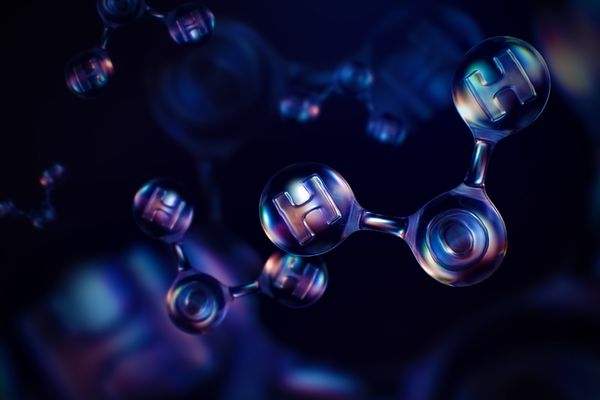
Contents of a water molecule
- Water molecules (H2O) are made from:
- One oxygen atom.
- Two hydrogen atoms.
Polarity
- Water is a polar molecule.
- The oxygen atoms in water are slightly negatively charged.
- The hydrogen atoms in water are slightly positively charged.

Hydrogen bonding
- When polar covalent bonds containing hydrogen form, the hydrogen in that bond has a slightly positive charge because hydrogen’s electron is pulled more strongly toward the other element and away from the hydrogen.
- Because the hydrogen is slightly positive, it will be attracted to neighboring negative charges.
- When this happens, a weak interaction occurs between the δ+of the hydrogen from one molecule and the δ– charge on the more electronegative atoms of another molecule.
Hydrogen bonding - importance
- The polarity of water molecules means that a hydrogen atom on one water molecule is attracted to the oxygen atom on another water molecule.
- This attraction is called hydrogen bonding.
- Hydrogen bonds provide many of the critical, life-sustaining properties of water,
- Hydrogen bonding also stabilizes the structures of proteins and DNA, the building block of cells.
Hydrogen Bonding & Water's Properties
Hydrogen bonding gives water its special characteristics, including cohesion, adhesion, and surface tension.

Cohesion
- Have you ever filled a glass of water to the very top and then slowly added a few more drops?
- Before it overflows, the water forms a dome-like shape above the rim of the glass.
- This water can stay above the glass because of the property of cohesion.
- In cohesion, water molecules are attracted to each other (because of hydrogen bonding), keeping the molecules together at the liquid-gas (water-air) interface, although there is no more room in the glass.
Surface tension
- Cohesion allows for the development of surface tension, the capacity of a substance to withstand being ruptured when placed under tension or stress.
- This is also why water forms droplets when placed on a dry surface rather than being flattened out by gravity.
- Cohesion and surface tension keep the hydrogen bonds of water molecules intact and support the item floating on the top.
,h_400,q_80,w_640.png)
Adhesion
- Cohesive forces are related to water’s property of adhesion, or the attraction between water molecules and other molecules.
- This attraction is sometimes stronger than water’s cohesive forces, especially when the water is exposed to charged surfaces such as those found on the inside of thin glass tubes known as capillary tubes.
Adhesion & capillary action
- Adhesion is observed when water “climbs” up the tube placed in a glass of water.
- Notice that the water appears to be higher on the sides of the tube than in the middle.
- This is because the water molecules are attracted to the charged glass walls of the capillary more than they are to each other and therefore adhere to it.
- This type of adhesion is called capillary action.

Cohesion & adhesion - importance
- Cohesive and adhesive forces are important for the transport of water from the roots to the leaves in plants.
- These forces create a “pull” on the water column.
- This pull results from the tendency of water molecules being evaporated on the surface of the plant to stay connected to water molecules below them, and so they are pulled along.
- Plants use this natural phenomenon to help transport water from their roots to their leaves.
1Unity & Diversity - Molecules
1.1Water
1.2DNA Structure & Replication
1.3Transcription & Gene Expression
2Unity & Diversity - Cells
2.1The Origin of Cells
2.2Introduction to Cells
2.3Ultrastructure of Cells
2.4Cell Division
2.5Structure of DNA & RNA
2.6DNA Replication, Transcription & Translation
2.7Cell Respiration
2.8Photosynthesis
2.9Viruses
3Unity & Diversity - Organisms
3.1Diversity of Organisms
3.2Evidence for Evolution
4Unity & Diversity - Ecosystems
4.1Classification
4.3Evolution & Speciation
4.3.1Evidence for Evolution - Fossils & DNA4.3.2Evidence for Evolution - Anatomy & Geography4.3.3IB Multiple Choice - Evidence for Evolution4.3.4Extended Response - DNA & Evolution4.3.5Populations4.3.6Mutations, Genetic Drift, & Gene Flow4.3.7Speciation4.3.8Rate of Speciation4.3.9Allopatric & Sympatric Speciation
4.4Conservation of Biodiversity
5Form & Function - Molecules
6Form & Function - Cells
6.1Membranes & Membrane Transport
6.2Organelles & Compartmentalization
6.3Cell Specialization
7Form & Function - Organisms
7.2Transport
7.3Muscle & Motility
8Form & Function - Ecosystems
8.1Species, Communities & Ecosytems
8.3Carbon Cycle
9Interaction & Interdependence - Molecules
9.1Enzymes
9.2Metabolism
9.3Cell Respiration
10Interaction & Interdependence - Cells
10.1Chemical Signalling
10.2Neural Signalling
10.3Adaptation to Environment
10.4Ecological Niches
11Interaction & Interdependence - Organisms
11.1Integration of Body Systems
12Interaction & Interdependence - Ecosystems
12.1Populations & Communities
12.2Transfers of Energy & Matter
13Continuity & Change - Molecules
13.1DNA Replication
13.2Protein Synthesis
14Continuity & Change - Cells
15Continuity & Change - Organisms
15.1Inheritance
15.1.1Non-Nuclear Inheritance15.1.2Linked Genes15.1.3IB Multiple Choice - Non-Mendelian Genetics15.1.4Extended Response - Inheritance15.1.5Introduction to Non-Mendelian Inheritance15.1.6Chi-Squared Test15.1.7End of Topic Quiz - Inheritance15.1.8Sex-Linked Genes15.1.9Grade 4-5 (Scientific Practices) - Inheritance
16Continuity & Change - Ecosystems
16.1Natural Selection
16.2Stability & Change
Jump to other topics
1Unity & Diversity - Molecules
1.1Water
1.2DNA Structure & Replication
1.3Transcription & Gene Expression
2Unity & Diversity - Cells
2.1The Origin of Cells
2.2Introduction to Cells
2.3Ultrastructure of Cells
2.4Cell Division
2.5Structure of DNA & RNA
2.6DNA Replication, Transcription & Translation
2.7Cell Respiration
2.8Photosynthesis
2.9Viruses
3Unity & Diversity - Organisms
3.1Diversity of Organisms
3.2Evidence for Evolution
4Unity & Diversity - Ecosystems
4.1Classification
4.3Evolution & Speciation
4.3.1Evidence for Evolution - Fossils & DNA4.3.2Evidence for Evolution - Anatomy & Geography4.3.3IB Multiple Choice - Evidence for Evolution4.3.4Extended Response - DNA & Evolution4.3.5Populations4.3.6Mutations, Genetic Drift, & Gene Flow4.3.7Speciation4.3.8Rate of Speciation4.3.9Allopatric & Sympatric Speciation
4.4Conservation of Biodiversity
5Form & Function - Molecules
6Form & Function - Cells
6.1Membranes & Membrane Transport
6.2Organelles & Compartmentalization
6.3Cell Specialization
7Form & Function - Organisms
7.2Transport
7.3Muscle & Motility
8Form & Function - Ecosystems
8.1Species, Communities & Ecosytems
8.3Carbon Cycle
9Interaction & Interdependence - Molecules
9.1Enzymes
9.2Metabolism
9.3Cell Respiration
10Interaction & Interdependence - Cells
10.1Chemical Signalling
10.2Neural Signalling
10.3Adaptation to Environment
10.4Ecological Niches
11Interaction & Interdependence - Organisms
11.1Integration of Body Systems
12Interaction & Interdependence - Ecosystems
12.1Populations & Communities
12.2Transfers of Energy & Matter
13Continuity & Change - Molecules
13.1DNA Replication
13.2Protein Synthesis
14Continuity & Change - Cells
15Continuity & Change - Organisms
15.1Inheritance
15.1.1Non-Nuclear Inheritance15.1.2Linked Genes15.1.3IB Multiple Choice - Non-Mendelian Genetics15.1.4Extended Response - Inheritance15.1.5Introduction to Non-Mendelian Inheritance15.1.6Chi-Squared Test15.1.7End of Topic Quiz - Inheritance15.1.8Sex-Linked Genes15.1.9Grade 4-5 (Scientific Practices) - Inheritance
16Continuity & Change - Ecosystems
16.1Natural Selection
16.2Stability & Change
Practice questions on Water & Hydrogen Bonding
Can you answer these? Test yourself with free interactive practice on Seneca — used by over 10 million students.
- 1Special properties of water include: True / false
- 2What % of the human body is made up of water?Multiple choice
- 3What are the components of a water molecule?Fill in the list
- 4What is the attraction between water molecules?Multiple choice
- 5
Unlock your full potential with Seneca Premium
Unlimited access to 10,000+ open-ended exam questions
Mini-mock exams based on your study history
Unlock 800+ premium courses & e-books