12.2.3
Photoelectricity
Test your knowledge with free interactive questions on Seneca — used by over 10 million students.
Einstein's Photon Model
Albert Einstein came up with the photon model of light to overcome the ultraviolet catastrophe.
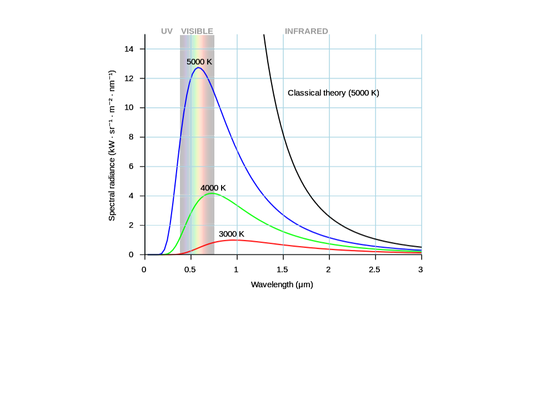
Black bodies
- A black body is an object which absorbs and emits 100% of the radiation incident upon it.
- Black bodies have a very specific emission spectrum.
The ultraviolet catastrophe
- Wave theory could not explain all of the intensity - wavelength graph for black bodies.
- This was known as the ultraviolet catastrophe.
- Wave theory predicted that the power output would continue to rise as the wavelength approached zero.
- The observation was that the power output curved back towards zero.

Einstein's photon model of light
- Max Planck suggested that electromagnetic waves might only be released in quanta.
- Einstein further suggested that electromagnetic waves can only exist in quanta, called photons.
- The photon model was able to explain the photoelectric effect, and the ultraviolet catastrophe.
1Measurements & Errors
1.1Measurements & Errors
1.1.1SI Base Units1.1.2Combining SI Units1.1.3Prefixes of Units1.1.4Standard Form1.1.5Converting Units1.1.6End of Topic Test - Units & Prefixes1.1.7Limitation of Physical Measurements1.1.8Uncertainty1.1.9Estimation1.1.10End of Topic Test - Measurements & Errors1.1.11Diagnostic Misconceptions - Converting between SI1.1.12Diagnostic Misconceptions - SI & Area/Volume
2Particles & Radiation
2.1Particles
2.1.1Atomic Model2.1.2Specific Charge, Protons & Neutron Numbers2.1.3End of Topic Test - Atomic Model2.1.4Isotopes2.1.5Stable & Unstable Nuclei2.1.6End of Topic Test - Isotopes & Nuclei2.1.7A-A* (AO3/4) - Stable & Unstable Nuclei2.1.8Particles, Antiparticles & Photons2.1.9Particle Interactions2.1.10Classification of Particles2.1.11End of Topic Test - Particles & Interactions2.1.12Quarks & Antiquarks2.1.13Application of Conservation Laws2.1.14End of Topic Test - Leptons & Quarks2.1.15Exam-Style Question - Radioactive Decay
2.2Electromagnetic Radiation & Quantum Phenomena
2.2.1The Photoelectric Effect2.2.2The Photoelectric Effect Explanation2.2.3End of Topic Test - The Photoelectric Effect2.2.4Collisions of Electrons with Atoms2.2.5Energy Levels & Photon Emission2.2.6Wave-Particle Duality2.2.7End of Topic Test - Absorption & Emission2.2.8Diagnostic Misconceptions - Electron Volts2.2.9Diagnostic Misconceptions - Converting eV & Joules
3Waves
3.1Progressive & Stationary Waves
3.2Refraction, Diffraction & Interference
4Mechanics & Materials
4.1Force, Energy & Momentum
4.1.1Scalars & Vectors4.1.2Vector Problems4.1.3End of Topic Test - Scalars & Vectors4.1.4Moments4.1.5Centre of Mass4.1.6End of Topic Test - Moments & Centre of Mass4.1.7Motion in a Straight Line4.1.8Graphs of Motion4.1.9Bouncing Ball Example4.1.10End of Topic Test - Motion in a Straight Line4.1.11Acceleration Due to Gravity4.1.12Projectile Motion4.1.13Friction4.1.14Terminal Speed4.1.15End of Topic Test - Acceleration Due to Gravity4.1.16Newton's Laws4.1.17Momentum4.1.18Momentum 24.1.19End of Topic Test - Newton's Laws & Momentum4.1.20A-A* (AO3/4) - Newton's Third Law4.1.21Work & Energy4.1.22Power & Efficiency4.1.23Conservation of Energy4.1.24End of Topic Test - Work, Energy & Power4.1.25Exam-Style Question - Forces4.1.26Diagnostic Misconceptions - Perpendicular Vectors4.1.27Diagnostic Misconceptions - Weight Acts Downwards4.1.28Diagnostic Misconceptions - Acceleration Direction4.1.29Diagnostic Misconceptions - Stationary Objects4.1.30Diagnostic Misconceptions - Action & Reaction4.1.31Diagnostic Misconceptions - RF Direction4.1.32Diagnostic Misconceptions - RF Acceleration4.1.33Diagnostic Misconceptions - Change in Momentum
5Electricity
5.1Current Electricity
5.1.1Basics of Electricity5.1.2Current-Voltage Characteristics5.1.3End of Topic Test - Basics of Electricity5.1.4Resistivity5.1.5Superconductivity5.1.6A-A* (AO3/4) - Superconductivity5.1.7End of Topic Test - Resistivity & Superconductors5.1.8Circuits5.1.9Power and Conservation5.1.10Potential Divider5.1.11Emf & Internal Resistance5.1.12End of Topic Test - Power & Potential5.1.13Exam-Style Question - Resistance5.1.14Diagnostic Misconceptions - Constant Current5.1.15Diagnostic Misconceptions - Potential Difference
6Further Mechanics & Thermal Physics (A2 only)
6.1Periodic Motion (A2 only)
6.2Thermal Physics (A2 only)
6.2.1Thermal Energy Transfer6.2.2Thermal Energy Transfer Experiments6.2.3Ideal Gases6.2.4Ideal Gases 26.2.5Boyle's Law & Charles' Law6.2.6Molecular Kinetic Theory Model6.2.7Molecular Kinetic Theory Model 26.2.8End of Topic Test - Thermal Energy & Ideal Gases6.2.9Exam-Style Question - Ideal Gases6.2.10Diagnostic Misconceptions - Material & Mass6.2.11Diagnostic Misconceptions - No Energy
7Fields & Their Consequences (A2 only)
7.1Fields (A2 only)
7.2Gravitational Fields (A2 only)
7.3Electric Fields (A2 only)
7.4Capacitance (A2 only)
7.5Magnetic Fields (A2 only)
7.5.1Magnetic Flux Density7.5.2End of Topic Test - Capacitance & Flux Density7.5.3Moving Charges in a Magnetic Field7.5.4Magnetic Flux & Flux Linkage7.5.5Electromagnetic Induction7.5.6Electromagnetic Induction 27.5.7Alternating Currents7.5.8Operation of a Transformer7.5.9Magnetic Flux Density7.5.10End of Topic Test - Electromagnetic Induction
8Nuclear Physics (A2 only)
8.1Radioactivity (A2 only)
8.1.1Rutherford Scattering8.1.2Alpha & Beta Radiation8.1.3Gamma Radiation8.1.4Radioactive Decay8.1.5Half Life8.1.6End of Topic Test - Radioactivity8.1.7Nuclear Instability8.1.8Nuclear Radius8.1.9Mass & Energy8.1.10Binding Energy8.1.11Induced Fission8.1.12Safety Aspects of Nuclear Reactors8.1.13End of Topic Test - Nuclear Physics8.1.14A-A* (AO3/4) - Nuclear Fusion
9Option: Astrophysics (A2 only)
9.1Telescopes (A2 only)
9.2Classification of Stars (A2 only)
9.3Cosmology (A2 only)
10Option: Medical Physics (A2 only)
10.1Physics of the Eye (A2 only)
10.2Physics of the Ear (A2 only)
10.3Biological Measurement (A2 only)
10.4Non-Ionising Imaging (A2 only)
10.5X-Ray Imaging (A2 only)
10.6Radionuclide Imaging & Therapy (A2 only)
11Option: Engineering Physics (A2 only)
11.1Rotational Dynamics (A2 only)
11.2Thermodynamics & Engines (A2 only)
12Option: Turning Points in Physics (A2 only)
12.1Discovery of the Electron (A2 only)
12.2Wave-Particle Duality (A2 only)
Jump to other topics
1Measurements & Errors
1.1Measurements & Errors
1.1.1SI Base Units1.1.2Combining SI Units1.1.3Prefixes of Units1.1.4Standard Form1.1.5Converting Units1.1.6End of Topic Test - Units & Prefixes1.1.7Limitation of Physical Measurements1.1.8Uncertainty1.1.9Estimation1.1.10End of Topic Test - Measurements & Errors1.1.11Diagnostic Misconceptions - Converting between SI1.1.12Diagnostic Misconceptions - SI & Area/Volume
2Particles & Radiation
2.1Particles
2.1.1Atomic Model2.1.2Specific Charge, Protons & Neutron Numbers2.1.3End of Topic Test - Atomic Model2.1.4Isotopes2.1.5Stable & Unstable Nuclei2.1.6End of Topic Test - Isotopes & Nuclei2.1.7A-A* (AO3/4) - Stable & Unstable Nuclei2.1.8Particles, Antiparticles & Photons2.1.9Particle Interactions2.1.10Classification of Particles2.1.11End of Topic Test - Particles & Interactions2.1.12Quarks & Antiquarks2.1.13Application of Conservation Laws2.1.14End of Topic Test - Leptons & Quarks2.1.15Exam-Style Question - Radioactive Decay
2.2Electromagnetic Radiation & Quantum Phenomena
2.2.1The Photoelectric Effect2.2.2The Photoelectric Effect Explanation2.2.3End of Topic Test - The Photoelectric Effect2.2.4Collisions of Electrons with Atoms2.2.5Energy Levels & Photon Emission2.2.6Wave-Particle Duality2.2.7End of Topic Test - Absorption & Emission2.2.8Diagnostic Misconceptions - Electron Volts2.2.9Diagnostic Misconceptions - Converting eV & Joules
3Waves
3.1Progressive & Stationary Waves
3.2Refraction, Diffraction & Interference
4Mechanics & Materials
4.1Force, Energy & Momentum
4.1.1Scalars & Vectors4.1.2Vector Problems4.1.3End of Topic Test - Scalars & Vectors4.1.4Moments4.1.5Centre of Mass4.1.6End of Topic Test - Moments & Centre of Mass4.1.7Motion in a Straight Line4.1.8Graphs of Motion4.1.9Bouncing Ball Example4.1.10End of Topic Test - Motion in a Straight Line4.1.11Acceleration Due to Gravity4.1.12Projectile Motion4.1.13Friction4.1.14Terminal Speed4.1.15End of Topic Test - Acceleration Due to Gravity4.1.16Newton's Laws4.1.17Momentum4.1.18Momentum 24.1.19End of Topic Test - Newton's Laws & Momentum4.1.20A-A* (AO3/4) - Newton's Third Law4.1.21Work & Energy4.1.22Power & Efficiency4.1.23Conservation of Energy4.1.24End of Topic Test - Work, Energy & Power4.1.25Exam-Style Question - Forces4.1.26Diagnostic Misconceptions - Perpendicular Vectors4.1.27Diagnostic Misconceptions - Weight Acts Downwards4.1.28Diagnostic Misconceptions - Acceleration Direction4.1.29Diagnostic Misconceptions - Stationary Objects4.1.30Diagnostic Misconceptions - Action & Reaction4.1.31Diagnostic Misconceptions - RF Direction4.1.32Diagnostic Misconceptions - RF Acceleration4.1.33Diagnostic Misconceptions - Change in Momentum
5Electricity
5.1Current Electricity
5.1.1Basics of Electricity5.1.2Current-Voltage Characteristics5.1.3End of Topic Test - Basics of Electricity5.1.4Resistivity5.1.5Superconductivity5.1.6A-A* (AO3/4) - Superconductivity5.1.7End of Topic Test - Resistivity & Superconductors5.1.8Circuits5.1.9Power and Conservation5.1.10Potential Divider5.1.11Emf & Internal Resistance5.1.12End of Topic Test - Power & Potential5.1.13Exam-Style Question - Resistance5.1.14Diagnostic Misconceptions - Constant Current5.1.15Diagnostic Misconceptions - Potential Difference
6Further Mechanics & Thermal Physics (A2 only)
6.1Periodic Motion (A2 only)
6.2Thermal Physics (A2 only)
6.2.1Thermal Energy Transfer6.2.2Thermal Energy Transfer Experiments6.2.3Ideal Gases6.2.4Ideal Gases 26.2.5Boyle's Law & Charles' Law6.2.6Molecular Kinetic Theory Model6.2.7Molecular Kinetic Theory Model 26.2.8End of Topic Test - Thermal Energy & Ideal Gases6.2.9Exam-Style Question - Ideal Gases6.2.10Diagnostic Misconceptions - Material & Mass6.2.11Diagnostic Misconceptions - No Energy
7Fields & Their Consequences (A2 only)
7.1Fields (A2 only)
7.2Gravitational Fields (A2 only)
7.3Electric Fields (A2 only)
7.4Capacitance (A2 only)
7.5Magnetic Fields (A2 only)
7.5.1Magnetic Flux Density7.5.2End of Topic Test - Capacitance & Flux Density7.5.3Moving Charges in a Magnetic Field7.5.4Magnetic Flux & Flux Linkage7.5.5Electromagnetic Induction7.5.6Electromagnetic Induction 27.5.7Alternating Currents7.5.8Operation of a Transformer7.5.9Magnetic Flux Density7.5.10End of Topic Test - Electromagnetic Induction
8Nuclear Physics (A2 only)
8.1Radioactivity (A2 only)
8.1.1Rutherford Scattering8.1.2Alpha & Beta Radiation8.1.3Gamma Radiation8.1.4Radioactive Decay8.1.5Half Life8.1.6End of Topic Test - Radioactivity8.1.7Nuclear Instability8.1.8Nuclear Radius8.1.9Mass & Energy8.1.10Binding Energy8.1.11Induced Fission8.1.12Safety Aspects of Nuclear Reactors8.1.13End of Topic Test - Nuclear Physics8.1.14A-A* (AO3/4) - Nuclear Fusion
9Option: Astrophysics (A2 only)
9.1Telescopes (A2 only)
9.2Classification of Stars (A2 only)
9.3Cosmology (A2 only)
10Option: Medical Physics (A2 only)
10.1Physics of the Eye (A2 only)
10.2Physics of the Ear (A2 only)
10.3Biological Measurement (A2 only)
10.4Non-Ionising Imaging (A2 only)
10.5X-Ray Imaging (A2 only)
10.6Radionuclide Imaging & Therapy (A2 only)
11Option: Engineering Physics (A2 only)
11.1Rotational Dynamics (A2 only)
11.2Thermodynamics & Engines (A2 only)
12Option: Turning Points in Physics (A2 only)
12.1Discovery of the Electron (A2 only)
12.2Wave-Particle Duality (A2 only)
Practice questions on Photoelectricity
Can you answer these? Test yourself with free interactive practice on Seneca — used by over 10 million students.
- 1What type of emission spectrum do black bodies have?Multiple choice
- 2
Unlock your full potential with Seneca Premium
Unlimited access to 10,000+ open-ended exam questions
Mini-mock exams based on your study history
Unlock 800+ premium courses & e-books