15.2.6
Adaptations of Plants to Rainforests
Test your knowledge with free interactive questions on Seneca — used by over 10 million students.
How Are Plants Adapted to Tropical Rainforests?
Plants have adapted to the tropical rainforest biome via evolution and natural selection. The adaptations have helped them to survive among the heavy precipitation and lack of sunlight on the rainforest floor.
,h_400,q_80,w_640.jpg)
Buttress roots
- Buttress roots are specially adapted tree roots that spread out across a very wide area and go deep underground.
- Being spread so wide and deep allows buttress roots to absorb more nutrients.
- However, they also spread out into the soil that other plants would use to absorb nutrients - so they compete with other plants for nutrients.

Waxy coating and pointed leaf tips
- Many leaves in tropical rainforests have a waxy coating. This helps the plants to resist the rain. Without the waxy coating, the leaves could absorb the rain and become so heavy that they would be pulled off the tree.
- The pointed leaf tips funnel the water off leaves in a single channel.
- Both of these adaptations stop the heavy rainfall from damaging the plant.

A smooth layer of thin bark
- Bark in the UK on trees like oak trees is very thick and rough.
- Tree bark usually tries to conserve water, but if anything, plants in a rainforest need to ensure that they don't absorb too much water.
- Having very smooth bark, like having a waxy coating on leaves, helps the rain to run off the tree easily.

Climbing vines/plants
- Lianas and other climbing vines/plants try to compete for sunlight by growing up other trees' tree trunks. This conserves energy and allows them to reach the sunlight that they need to photosynthesise and survive.

Adapted to a particular layer
- There are 4 layers of flora in tropical rainforests. A plant living at each layer will adapt differently to survive:
- The top layer is called the emergent layer and this layer captures the most sunlight. Being the tallest plant matters more here.
- The lowest layer is called the forest floor. Plants are more likely to have a high surface area on their leaves to absorb the most sunlight here.
Plant Biodiversity in Tropical Rainforests
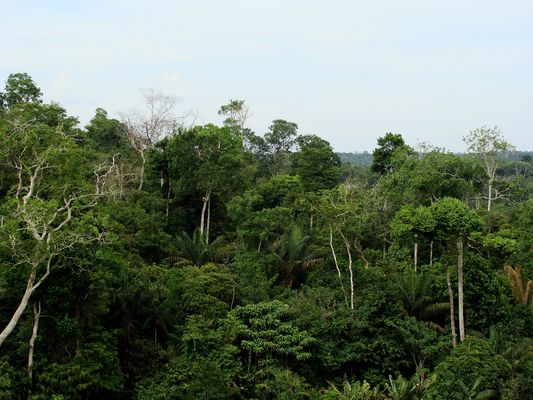
Rainforests house 50% of the known plant, animal and insect species. Plants in rainforests have adaptations to help them cope with the high rainfall and heat, as well as the competition for light.
Stable and productive environments
- The consistent climate of rainforests means that:
- Rainforest ecosystems are stable because organisms don't have to cope with changing conditions.
- Rainforest ecosystems are productive because there's always lots of food.

Buttress roots
- Buttress roots are big roots that support the trunks of tall trees.

Thick, waxy leaves with pointed tips
- Having a waxy coating helps the leaves repel rain.
- Pointed tips help run-off by channelling the water to a point. This means:
- The weight of the water doesn't harm the plant.
- Fungi and bacteria can't grow as there's no standing water.

Smooth, thin bark
- Thick bark isn't necessary as trees aren't exposed to cold temperatures.
- Smooth, thin bark helps water run-off.

Climbing plants
- Climbing plants (e.g. lianas) use the tree trunks to drag themselves up towards the light.

Gradual and consistent dropping of leaves
- This allows plants to continue growing year-round.
Adapted to a particular layer
- There are four distinct layers of plants in tropical rainforests, each with their own special adaptations.
1Geography Skills
1.1Mapping
2Geology of the UK
2.1The UK's Rocks
2.2Case Study: The Peak District
3Geography of the World
4Development
4.1Development
4.2Uneven Development
4.3Case Study: Democratic Republic of Congo
5Weather & Climate
5.1Weather
5.2Climate
6The World of Work
7Natural Resources
7.1Rocks
8Rivers
8.1River Processes & Landforms
8.2Rivers & Flooding
9Coasts
9.1Formation of Coastal Landforms
10Glaciers
10.1Overview of Glaciers & How They Work
11Tectonics
11.1Continental Drift & Plate Tectonics
11.2Volcanoes
11.3Earthquakes
11.5Managing the Risk of Volcanoes & Earthquakes
12Climate Change
12.1The Causes & Consequences of Climate Change
13Global Population & Inequality
14Urbanisation
14.1Urbanisation
15Ecosystems
15.1The Major Biomes
15.2Case Study: The Amazon Rainforest
16Life in an Emerging Country
16.1Case Studies
17Analysis of Africa
17.1Africa
18Analysis of India
18.1India - Physical Geography
19Analysis of the Middle East
19.1The Middle East
20Analysis of Bangladesh
20.1Bangladesh Physical Geography
21Analysis of Russia
21.1Russia's Physical Geography
21.2Russia's Human Geography
Jump to other topics
1Geography Skills
1.1Mapping
2Geology of the UK
2.1The UK's Rocks
2.2Case Study: The Peak District
3Geography of the World
4Development
4.1Development
4.2Uneven Development
4.3Case Study: Democratic Republic of Congo
5Weather & Climate
5.1Weather
5.2Climate
6The World of Work
7Natural Resources
7.1Rocks
8Rivers
8.1River Processes & Landforms
8.2Rivers & Flooding
9Coasts
9.1Formation of Coastal Landforms
10Glaciers
10.1Overview of Glaciers & How They Work
11Tectonics
11.1Continental Drift & Plate Tectonics
11.2Volcanoes
11.3Earthquakes
11.5Managing the Risk of Volcanoes & Earthquakes
12Climate Change
12.1The Causes & Consequences of Climate Change
13Global Population & Inequality
14Urbanisation
14.1Urbanisation
15Ecosystems
15.1The Major Biomes
15.2Case Study: The Amazon Rainforest
16Life in an Emerging Country
16.1Case Studies
17Analysis of Africa
17.1Africa
18Analysis of India
18.1India - Physical Geography
19Analysis of the Middle East
19.1The Middle East
20Analysis of Bangladesh
20.1Bangladesh Physical Geography
21Analysis of Russia
21.1Russia's Physical Geography
21.2Russia's Human Geography
Practice questions on Adaptations of Plants to Rainforests
Can you answer these? Test yourself with free interactive practice on Seneca — used by over 10 million students.
- 1How are plants adapted to tropical rainforests?Fill in the list
- 2
- 3
- 4
Unlock your full potential with Seneca Premium
Unlimited access to 10,000+ open-ended exam questions
Mini-mock exams based on your study history
Unlock 800+ premium courses & e-books