1.1.30
Calculating Bacteria
Test your knowledge with free interactive questions on Seneca — used by over 10 million students.
Population of Bacteria
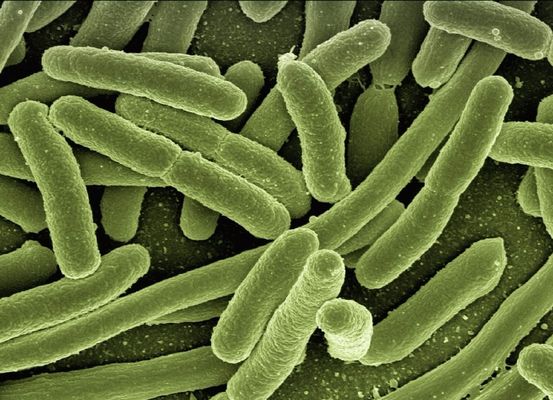
Bacteria multiply through simple cell division (binary fission), in which one cell divides to produce two cells. The average time for how often the bacteria divide is called the mean division time of that population.

Estimation
- A future population of bacteria can be estimated by multiplying the current population by two for every mean division time (time it takes for the bacteria to divide) that passes.
- Divisions can happen as fast as every 20 minutes when the conditions are ideal.
Equation
To calculate the future population of bacteria, we multiply the current population by 2 to the power of (time passed ÷ mean division time).
As an equation, that's current population x (2 ^ ).
1Cell Biology
1.1What's in Cells?
1.2Cell Division
1.3Transport in Cells
2Organisation
2.1Principles of Organisation
2.2Enzymes
2.3Circulatory System
2.4Non-Communicable Diseases
2.5Plant Tissues, Organs & Systems
3Infection & Response
3.1Communicable Disease
3.2Monoclonal Antibodies
4Bioenergetics
4.1Photosynthesis
5Homeostasis & Response
5.1Homeostasis
5.2The Human Nervous System
5.3Hormonal Coordination in Humans
6Inheritance, Variation & Evolution
6.1Reproduction
6.2Variation & Evolution
6.3Genetics & Evolution
7Ecology
7.1Adaptations & Interdependence
7.2Organisation of Ecosystems
7.3Biodiversity
7.4Trophic Levels
Jump to other topics
1Cell Biology
1.1What's in Cells?
1.2Cell Division
1.3Transport in Cells
2Organisation
2.1Principles of Organisation
2.2Enzymes
2.3Circulatory System
2.4Non-Communicable Diseases
2.5Plant Tissues, Organs & Systems
3Infection & Response
3.1Communicable Disease
3.2Monoclonal Antibodies
4Bioenergetics
4.1Photosynthesis
5Homeostasis & Response
5.1Homeostasis
5.2The Human Nervous System
5.3Hormonal Coordination in Humans
6Inheritance, Variation & Evolution
6.1Reproduction
6.2Variation & Evolution
6.3Genetics & Evolution
7Ecology
7.1Adaptations & Interdependence
7.2Organisation of Ecosystems
7.3Biodiversity
7.4Trophic Levels
Practice questions on Calculating Bacteria
Can you answer these? Test yourself with free interactive practice on Seneca — used by over 10 million students.
- 1
- 2
- 3
- 4How do bacteria multiply?Multiple choice
- 5
Unlock your full potential with Seneca Premium
Unlimited access to 10,000+ open-ended exam questions
Mini-mock exams based on your study history
Unlock 800+ premium courses & e-books