13.2.2
Operation of a Transformer
Test your knowledge with free interactive questions on Seneca — used by over 10 million students.
Transformers
Transformers can be used to convert an alternating current from one voltage to another.
 - Transformer-secondary-coil-min,h_400,q_80,w_640.jpg)
Transforming voltage
- The output voltage of a transformer can be less than, greater than, or equal to the input voltage.
- This depends on the ratio of the number of loops in their coil.

Types of transformers
- There are two classes of transformers:
- Step-up transformers increase voltage.
- Step-down transformers decrease voltage.
Transformer equation
- Assuming that resistance is negligible, the electrical power output of a transformer equals its input.
- We can combine this with the transformer equation () to get:
Efficiency of a Transformer
Modern transformers are very efficient. They waste little energy as heat because of improvements in design over time.

Eddy currents
- The core is made of iron, which is a magnetic metal.
- As the magnetic flux in the core changes, the free electrons in the iron experience a force which causes them to move.
- The moving electrons mean that a current has been induced in the core.
- These currents are known as “eddy currents” and cause the core to heat up.
Reducing eddy currents
- Eddy currents can be reduced by forming the core out of layers of iron glued together with an insulator.
- The magnetic properties are not severely reduced but the resistance (and so current in) the core is dramatically reduced.
- This process is known as “laminating the core”.
Examples of other losses
- Energy can still be lost by the changing magnetic field, causing the layers of iron to vibrate.
- The wire forming the coils has resistance, so will heat up when a current flows.
- Not all of the flux may pass from the primary to the secondary coil.
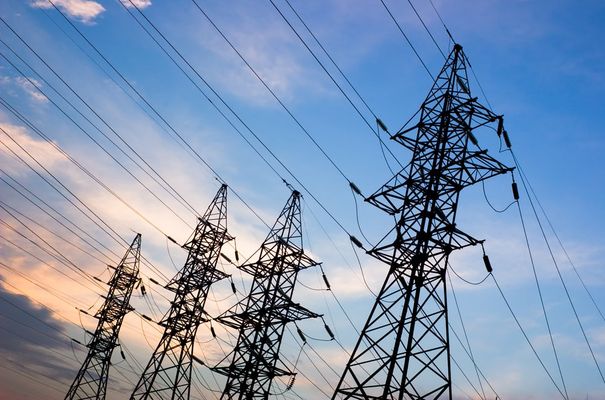
Transmission of Electrical Power
Transformers are used to either step-up an a.c. potential difference or to step it down. An important application is in mains transmission via the National Grid.

National Grid
- The National Grid produces a.c. in power stations.
- Typically this is around 15 kV.
- The step-up transformer steps the p.d. up to an RMS (root mean square - a type of average) amplitude of 330 kV.
- The p.d. is then stepped back down so that consumers can apply it more safely (and at a higher current).
Transformer power equation
- Since the input power = output power for a 100% efficient transformer:
- If the output transformer has more turns on it than the input transformer, causing , then the output current is less than the input current.
Reducing transmission losses
- A lower current through the transmission cables means less energy is wasted heating the surroundings.
- This is because the heating loss per metre of cable = I2R, where R is the resistance of 1 metre of cable.
1Physical Quantities & Units
1.1Physical Quantities & Units
2Kinematics
3Dynamics
3.1Momentum & Newton's Laws of Motion
3.2Non-Uniform Motion
3.3Linear Momentum & Conservation
4Force, Density & Pressure
4.1Force, Density & Pressure
4.1.1Fields4.1.2Force in Uniform Fields4.1.3Friction4.1.4Buoyancy4.1.5Terminal Speed4.1.6End of Topic Test - Acceleration Due to Gravity4.1.7Centre of Mass4.1.8Forces & Equilibrium4.1.9End of Topic Test - Scalars & Vectors4.1.10Moments4.1.11End of Topic Test - Moments & Centre of Mass4.1.12Density4.1.13Pressure
5Work, Energy & Power
6Deformation of Solids
7Waves
7.1Simple Harmonic Motion
7.2Waves
7.2.1Progressive Waves7.2.2Intensity of Waves7.2.3Wave Speed & Phase Difference7.2.4Longitudinal & Transverse Waves7.2.5End of Topic Test - Progressive Waves7.2.6Electromagnetic Waves7.2.7Doppler Effect7.2.8Sound Waves7.2.9Measuring Sound Waves7.2.10End of Topic Test - Waves7.2.11Ultrasound Imaging7.2.12Ultrasound Imaging 2
8Superposition
9Thermal Physics
9.1Circular Motion
9.2Thermal Physics
9.2.1Temperature9.2.2Measuring Temperature9.2.3Ideal Gas Law9.2.4Ideal Gases9.2.5Boyle's Law & Charles' Law9.2.6Molecular Kinetic Theory Model9.2.7Molecular Kinetic Theory Model 29.2.8Thermal Energy Transfer9.2.9Thermal Energy Transfer Experiments9.2.10End of Topic Test - Thermal Energy & Ideal Gases9.2.11First Law of Thermodynamics
10Communication
10.1Communication Channels
10.2Digital Communication
11Electric Fields
11.1Electric Fields
12Current Electricity
12.1Current Electricity
12.1.1Basics of Electricity12.1.2Mean Drift Velocity12.1.3Current-Voltage Characteristics12.1.4End of Topic Test - Basics of Electricity12.1.5Resistivity12.1.6End of Topic Test - Resistivity & Superconductors12.1.7Power and Conservation12.1.8Microphones12.1.9Components12.1.10Relays12.1.11Strain Gauges
13Magnetic Fields
13.1Magnetic Fields
14Modern Physics
14.1Quantum Physics
14.1.1The Photoelectric Effect14.1.2The Photoelectric Effect Explanation14.1.3End of Topic Test - The Photoelectric Effect14.1.4Collisions of Electrons with Atoms14.1.5Energy Levels & Photon Emission14.1.6Wave-Particle Duality14.1.7End of Topic Test - Absorption & Emission14.1.8Band Theory14.1.9Diagnostic X-Rays14.1.10X-Ray Image Processing14.1.11Absorption of X-Rays14.1.12CT Scanners
14.2Nuclear Physics
14.2.1Rutherford Scattering14.2.2Atomic Model14.2.3Isotopes14.2.4Stable & Unstable Nuclei14.2.5A-A* (AO3/4) - Stable & Unstable Nuclei14.2.6Alpha & Beta Radiation14.2.7Gamma Radiation14.2.8Particles, Antiparticles & Photons14.2.9Quarks & Antiquarks14.2.10Particle Interactions14.2.11Radioactive Decay14.2.12Half Life14.2.13End of Topic Test - Radioactivity14.2.14Nuclear Instability14.2.15Mass & Energy14.2.16Binding Energy14.2.17A-A* (AO3/4) - Nuclear Fusion
Jump to other topics
1Physical Quantities & Units
1.1Physical Quantities & Units
2Kinematics
3Dynamics
3.1Momentum & Newton's Laws of Motion
3.2Non-Uniform Motion
3.3Linear Momentum & Conservation
4Force, Density & Pressure
4.1Force, Density & Pressure
4.1.1Fields4.1.2Force in Uniform Fields4.1.3Friction4.1.4Buoyancy4.1.5Terminal Speed4.1.6End of Topic Test - Acceleration Due to Gravity4.1.7Centre of Mass4.1.8Forces & Equilibrium4.1.9End of Topic Test - Scalars & Vectors4.1.10Moments4.1.11End of Topic Test - Moments & Centre of Mass4.1.12Density4.1.13Pressure
5Work, Energy & Power
6Deformation of Solids
7Waves
7.1Simple Harmonic Motion
7.2Waves
7.2.1Progressive Waves7.2.2Intensity of Waves7.2.3Wave Speed & Phase Difference7.2.4Longitudinal & Transverse Waves7.2.5End of Topic Test - Progressive Waves7.2.6Electromagnetic Waves7.2.7Doppler Effect7.2.8Sound Waves7.2.9Measuring Sound Waves7.2.10End of Topic Test - Waves7.2.11Ultrasound Imaging7.2.12Ultrasound Imaging 2
8Superposition
9Thermal Physics
9.1Circular Motion
9.2Thermal Physics
9.2.1Temperature9.2.2Measuring Temperature9.2.3Ideal Gas Law9.2.4Ideal Gases9.2.5Boyle's Law & Charles' Law9.2.6Molecular Kinetic Theory Model9.2.7Molecular Kinetic Theory Model 29.2.8Thermal Energy Transfer9.2.9Thermal Energy Transfer Experiments9.2.10End of Topic Test - Thermal Energy & Ideal Gases9.2.11First Law of Thermodynamics
10Communication
10.1Communication Channels
10.2Digital Communication
11Electric Fields
11.1Electric Fields
12Current Electricity
12.1Current Electricity
12.1.1Basics of Electricity12.1.2Mean Drift Velocity12.1.3Current-Voltage Characteristics12.1.4End of Topic Test - Basics of Electricity12.1.5Resistivity12.1.6End of Topic Test - Resistivity & Superconductors12.1.7Power and Conservation12.1.8Microphones12.1.9Components12.1.10Relays12.1.11Strain Gauges
13Magnetic Fields
13.1Magnetic Fields
14Modern Physics
14.1Quantum Physics
14.1.1The Photoelectric Effect14.1.2The Photoelectric Effect Explanation14.1.3End of Topic Test - The Photoelectric Effect14.1.4Collisions of Electrons with Atoms14.1.5Energy Levels & Photon Emission14.1.6Wave-Particle Duality14.1.7End of Topic Test - Absorption & Emission14.1.8Band Theory14.1.9Diagnostic X-Rays14.1.10X-Ray Image Processing14.1.11Absorption of X-Rays14.1.12CT Scanners
14.2Nuclear Physics
14.2.1Rutherford Scattering14.2.2Atomic Model14.2.3Isotopes14.2.4Stable & Unstable Nuclei14.2.5A-A* (AO3/4) - Stable & Unstable Nuclei14.2.6Alpha & Beta Radiation14.2.7Gamma Radiation14.2.8Particles, Antiparticles & Photons14.2.9Quarks & Antiquarks14.2.10Particle Interactions14.2.11Radioactive Decay14.2.12Half Life14.2.13End of Topic Test - Radioactivity14.2.14Nuclear Instability14.2.15Mass & Energy14.2.16Binding Energy14.2.17A-A* (AO3/4) - Nuclear Fusion
Practice questions on Operation of a Transformer
Can you answer these? Test yourself with free interactive practice on Seneca — used by over 10 million students.
- 1What is the equation for the power of a transformer?Multiple choice
- 2Formation of Eddy Current in TransformersPut in order
- 3
- 4
- 5Transformers in the National GridPut in order
Unlock your full potential with Seneca Premium
Unlimited access to 10,000+ open-ended exam questions
Mini-mock exams based on your study history
Unlock 800+ premium courses & e-books